“Can you hear me?”The phone drops. The call fails. You’re standing in the middle of a concrete parking garage trying to reach your teammate on Level 4. The app you both downloaded? Stuck loading. Your signal? Somewhere with better reception.
Meanwhile, the security guard two feet away presses a button and says, “Got it. I’m on my way.”
No delay. No buffering. No excuses.
Welcome to the world of voice-first communication and the humble two-way radio that still owns it.
Phones Are Cool. Until They’re Not.
In theory, smartphones can do everything.
But in practice? They hesitate. They drop calls. They need Wi-Fi. And when things get loud, chaotic, or urgent? They’re basically Instagram machines.
Voice-first environments—think stadiums, hospitals, job sites—don’t have time for loading screens. People need to speak. And be heard. Now.
That’s why the two-way radio, decades old and still evolving, remains undefeated.
Push-to-Talk > Push Notifications
Ever tried typing a Slack message while wearing gloves? Or waiting for a group chat to load during a power outage?
Exactly.
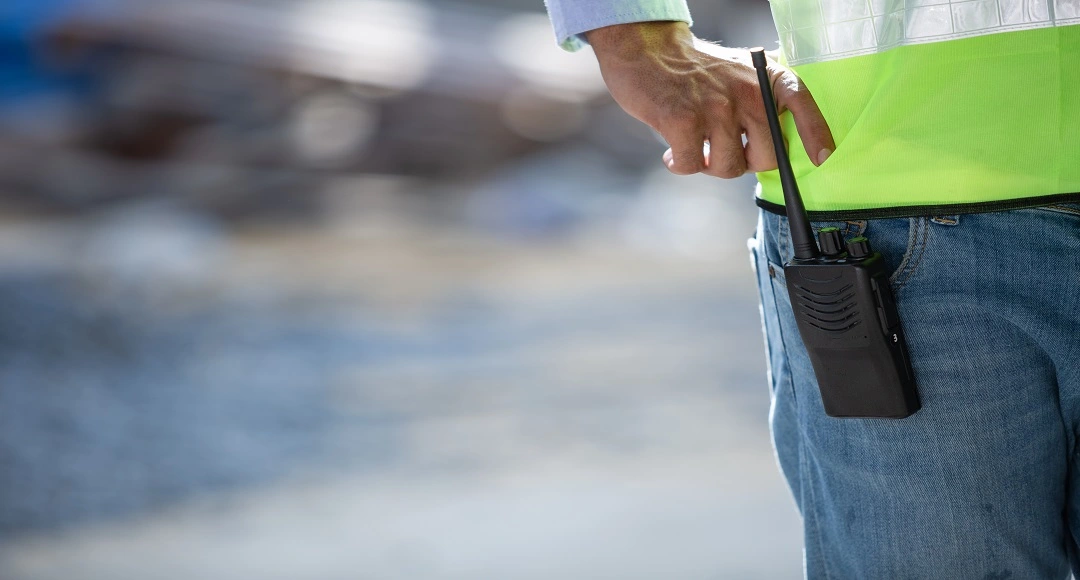
Push-to-talk radios aren’t just convenient—they’re instant. Press a button, and your voice cuts through the noise. Everyone hears it. No typing. No apps. No, “Can you see my message?”
It’s the difference between real-time communication and “wait, what did they say?”
Voice-First Isn’t a Trend—It’s a Survival Strategy
Voice-first communication isn’t just faster—it’s safer. Smarter. More human.
Picture this:
- A foreman hears “Backhoe’s down—site 2” before anyone texts it.
- A nurse calls security without pulling out a phone.
- A retail associate discreetly requests backup without leaving a customer.
These aren’t hypotheticals. They’re everyday moments powered by the magic of speak-and-go.
But… Aren’t Two-Way Radios Old School?
Yes. In the best way possible.
Old-school in the way vinyl is. Or cast iron skillets. Or handshakes.
Built to last. No fluff. No overthinking.
But don’t get it twisted—today’s radios aren’t frozen in time. Some models use nationwide LTE networks or Wi-Fi to go well beyond the parking lot or warehouse floor.
So, yeah—“old” just got a major upgrade.
Where Voice Reigns Supreme
Want to know where these radios are quietly crushing it? Pretty much anywhere screens are a problem.
Hotels & Resorts
“Room 215 needs fresh towels.” That call? Better fast and discreet than delayed and forgotten.
Construction Sites
Bulldozers don’t care about notifications. You need rugged gear and instant reach.
Retail Floors
Price check? Spill in Aisle 9? Manager needed at checkout? No one’s scrolling for solutions.
Hospitals & Emergency Teams
In high-stress, high-stakes moments, voice cuts through everything.
Education Campuses
From daily logistics to emergency drills, one push keeps staff connected.
Voice: The Most Underrated Tech of the Decade?
Let’s be honest—texting isn’t always faster. And typing instructions during a crisis? Yikes.
Two-way radios are fast. Purpose-built. Zero distraction.
They’re the antidote to screen fatigue, app overload, and digital noise.
And in voice-first environments, they’re not optional—they’re essential.
So… Why Are We Still Talking About Radios?
Because they work.
Because in a world obsessed with features, sometimes you just need function.
And because the fastest way to be heard still starts with a button, not a browser.
Final Thought: In the End, Clarity Wins
Communication isn’t about emojis. It’s about getting through especially when it matters most.
So next time someone suggests “just using a phone,” hand them a radio and say, “Try pushing this.”
Because sometimes, the simplest tools speak the loudest.
Read More: sohohindipro net: Full Details, Bio Ideas, Status & Alternatives