
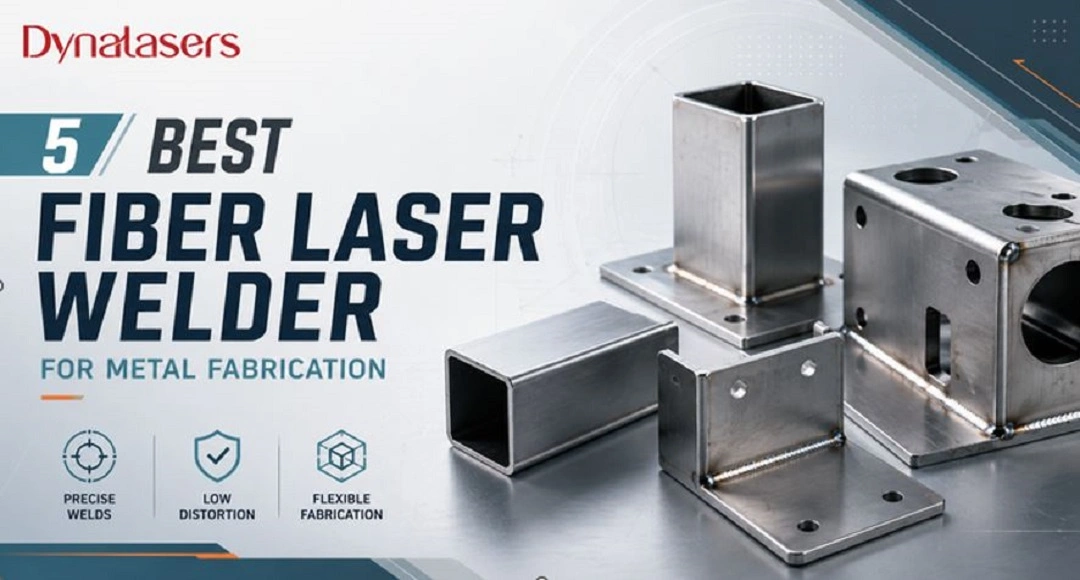
A good fiber laser welder is not necessarily the machine with the biggest number on the specification sheet. An 1800W system can be useful in one workshop and excessive in another. Thin stainless housings, aluminum repair work, fabrication benches, and regular production all need a different balance of power, mobility, cooling, and wire feeding.
For shops comparing equipment in 2026, the five systems below cover everything from compact air-cooled machines to heavier industrial setups.
Comparison of the 5 Best Fiber Laser Welders
| Brand / Series | Power | Cooling / Type | Main Strength | Main Limitation | Best Fit |
| Dynalasers S / M / D Series | 700W–1800W | Air-cooled handheld | Broad power range, compact cabinet, light gun, multi-process use | Not designed around heavy 2–3kW production | Repair, flexible fabrication, mobile and workshop use |
| IPG LightWELD | 1000W–2000W | Handheld | Established industrial platform and process presets | Higher equipment investment | Professional fabrication |
| xTool MetalFab | 800W / 1200W | Air-cooled | Compact and relatively accessible | Lower maximum output | Light fabrication and small shops |
| JASIC LS Series | 1500W / 2000W | Water-cooled | Higher output for regular production | Larger cooling system | Industrial shop-floor welding |
| SENFENG Portable Series | 800W–1500W | Handheld | Several power options | Less output at the top end | General repair and fabrication |
Dynalasers covers an unusually wide range within an air-cooled format. The S Series sits at the lightweight end, while M and D models reach up to 1800W for more demanding work.
That range matters because portability is not useful if a machine cannot weld the material normally seen in the shop. At the same time, buying much more power than needed adds cost without necessarily improving the job.
What Is Fiber Laser Welding?
Fiber laser welding uses a tightly focused laser beam to melt the edges of a metal joint. The heat is concentrated in a small zone rather than spreading across a wide area, which is why laser welds can be narrow and distortion can be lower than with many conventional processes.
In a handheld system, the beam travels through an optical fiber to the welding head. The operator moves the gun along the joint much like a torch, although the way the heat enters the metal is very different.
A modern fiber laser welder for metal may allow adjustment of power, beam wobble, travel speed, wire feed, and other parameters. These controls are important because the same setting that gives a clean seam on 1 mm stainless sheet may perform poorly on aluminum, galvanized steel, or a thicker carbon-steel joint.
How Does Fiber Laser Welding Actually Work?
The beam first heats a very small area of the joint. Depending on the energy density and material, welding may remain relatively shallow or develop into a deeper keyhole-type process.
Handheld systems often use wobble rather than sending the beam along a perfectly straight, narrow line. The spot moves from side to side in a controlled pattern. That creates a wider working area and can make the process less unforgiving when joint fit-up is not absolutely perfect.
Wire feeding changes things again. A close-fitting seam may be welded autogenously, while a joint with a visible gap may need filler wire to provide enough metal and create the desired bead shape.
This is why fiber optic laser welding cannot really be reduced to “more watts equals a better weld.” Focus, fit-up, surface condition, wire position, gas coverage, speed, and operator movement all matter.
Why Shops Move to Fiber Laser Welding
The attraction is easy to understand once the work involves thin sheet and visible seams.
A concentrated heat source can reduce the amount of surrounding metal that becomes hot. On stainless cabinets, kitchen equipment, machine covers, doors, enclosures, and decorative parts, that often means less warping and less straightening afterward.
Grinding can also be reduced when the bead is properly controlled. That saves more than abrasive discs. It removes a finishing step that can consume a surprising amount of labor on short-run fabrication.
Speed is another reason shops look at the process. Once the joint and parameters are stable, a fiber laser welding machine can move quickly through repeat seams.
There are limits, though. A dirty gap-filled joint that a MIG welder can bridge without much thought may frustrate a laser operator. Heavy structural sections, poor fit-up, and code-controlled work can still favor established TIG, MIG, or automated welding procedures.
Where Fiber Laser Welding Fits Best
Handheld systems make the most sense where the work changes regularly.
A typical fabrication shop may weld a stainless enclosure in the morning, repair an aluminum frame after lunch, then finish a batch of sheet-metal brackets before closing. This kind of mixed workload is where a flexible handheld system earns its place.
Common jobs include:
- Stainless steel cabinets and enclosures
- Aluminum frames and repair sections
- Sheet-metal equipment covers
- Kitchen and food-service products
- Doors and metal furniture
- Automotive repair components
- Brackets, frames, and small assemblies
Part preparation still has a direct effect on the result. Oil, paint, oxide, moisture, or inconsistent gaps can cause porosity, incomplete fusion, blackened welds, or irregular penetration.
For unfamiliar materials, the sensible approach is to make sample welds first and cut or test them if the joint is important. A nice-looking top bead does not always tell the whole story.
Where Dynalasers Fits
Dynalasers approaches handheld laser welding through three different product families rather than trying to make one cabinet cover every job.
The S Series is built around mobility. M models sit in the middle for regular fabrication, while the D Series increases output and multi-process capability for busier workshop use.
All three use air cooling, which removes the separate water chiller found on many traditional systems. That has a practical effect on footprint, setup, and maintenance, especially where the welder needs to be moved between work areas.
Across the range, key features include 700W to 1800W output options, lightweight handheld guns on selected models, wire feeding, and combinations of welding, cleaning, and light cutting.
That versatility is useful, but it does not remove the normal process requirements. A compact laser source still needs clean joints, stable gas coverage, suitable wire, and sensible parameters.
Dynalasers M Series for Everyday Fabrication
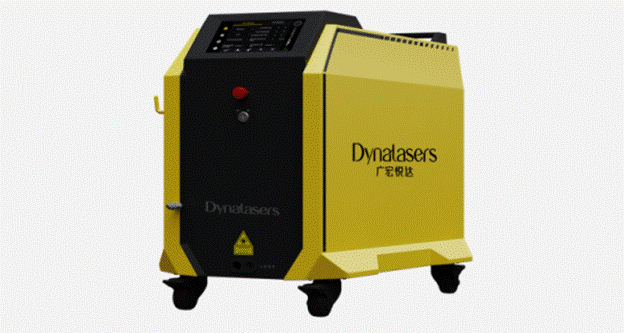
The M Series is probably the easiest place to start for a workshop that handles a mixture of sheet-metal work and repair.
M30, M50, and M70 provide approximately 800W, 1200W, and 1800W. Instead of being tied to welding alone, these machines can also handle cleaning and light handheld cutting.
That makes the M Series practical when a job does not arrive at the bench ready to weld. A repair section may need rust or oxide removed first. Another part may need a small cut before fitting. Using one system for several steps can be more useful than having the highest possible welding power.
The 1800W M70 sits at the stronger end of the range, while the smaller versions make more sense for lighter work where mobility and lower power demand matter.
Best fit: General fabrication, stainless products, frames, enclosures, repair work, and mixed daily jobs.
Dynalasers D Series for More Demanding Workshop Work
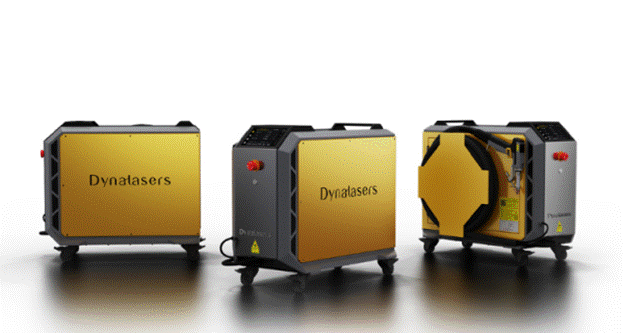
The D Series moves closer to heavier daily fabrication.
D50, D60, and D70 cover roughly 1200W, 1500W, and 1800W. Selected models support continuous, spot, and pulse welding, along with cleaning and light cutting functions.
The D60 is an interesting middle point. At 1500W, it gives noticeably more process margin than the lighter systems without moving into a traditional water-cooled cabinet. For shops regularly switching between steel, stainless, aluminum, and maintenance work, that balance can be useful.
Higher-power D models also make more sense when the normal workload includes thicker sections rather than occasional thin-sheet jobs.
Best fit: Regular fabrication, machinery repair, aluminum frames, stronger steel work, and shops that want several metal-processing functions in one unit.
Dynalasers S Series When Weight Matters
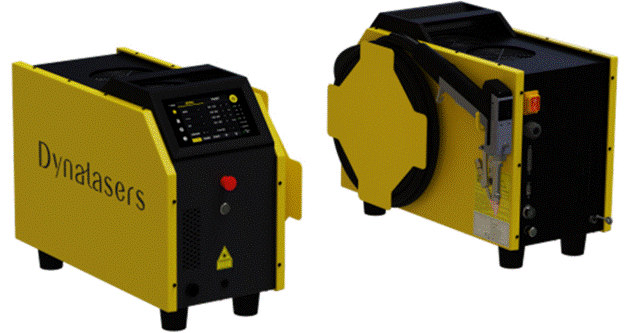
The S Series solves a different problem.
The S30 produces 700W but weighs less than 21 kg, with dimensions around 507 × 230 × 349 mm. It can run continuous, burst, and pulse modes and is aimed at jobs where carrying or repositioning the machine matters more than maximum welding depth.
That makes it relevant to mobile repair, field maintenance, small workshops, and short seams on thin material. Under suitable conditions, stainless-steel welding depth is around 2.5 mm.
A heavier 1800W machine will obviously offer more capability on thicker metal. But when most of the work is thin sheet and the welder regularly moves between locations, that extra capacity may not justify the extra bulk.
Best fit: Mobile maintenance, compact shops, thin sheet, on-site repair, and light fabrication.
What Usually Determines Weld Quality
The machine is only one part of the result.
Poor fit-up is one of the first problems to show itself in handheld laser welding. Surface contamination is another. Shielding gas that misses the weld zone can quickly affect appearance and porosity, while incorrect focus or travel speed changes penetration.
Wire feed deserves attention too. Too much wire can leave a bulky bead; too little can fail to fill the joint.
A new material, thickness, or joint type should therefore be treated as a new setup rather than assuming a saved preset will work unchanged.
Laser safety is equally important. High-power handheld fiber lasers require controlled work areas, suitable eye protection, fume extraction, restricted access, fire precautions, and trained operators.
FAQs
Can you weld with a fiber laser?
Yes. Stainless steel, carbon steel, aluminum, copper, galvanized sheet, and several other metals can be laser welded when the machine and parameters match the material.
How much does a fiber laser welding machine cost?
There is no single price range. Power, cooling, wire feeding, accessories, safety equipment, warranty, and service all change the final cost.
Is laser welding as strong as MIG?
It can be. Strength depends on penetration, joint design, filler material, and weld quality rather than whether the process is laser or MIG.
What are the downsides of laser welding?
Equipment cost, stricter laser safety, tighter joint fit-up, and sensitivity to parameters are the main tradeoffs.
Conclusion
The best fiber laser welder is the one that fits the normal work in the shop, not the machine with the highest advertised wattage.
Dynalasers covers different workloads with three air-cooled families. S models focus on portability, M models suit mixed everyday fabrication, and D models add more power for regular workshop use.
Fiber laser welding can cut heat input, finishing work, and welding time on the right parts. The real test, however, is still the same as with any welding process: put the actual material on the bench, establish a stable parameter window, and judge the finished joint rather than the brochure.
Read More: Rebel Creamery Ice Cream Lawsuit: Why Van Leeuwen Sued for $23.8M