
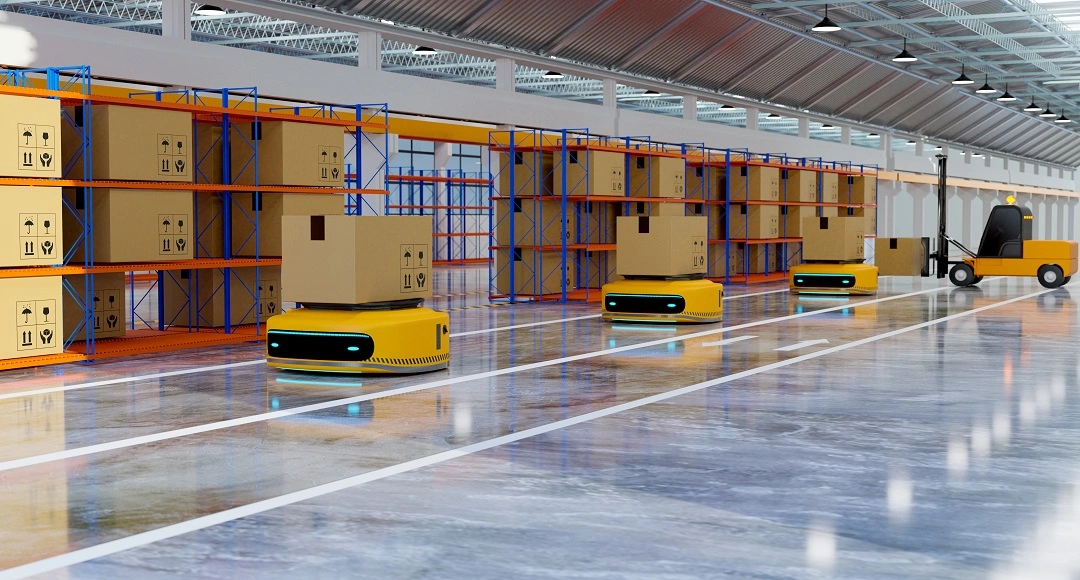
Indian warehouses are handling more varieties of products compared to the past. The movement of cartons, totes, pallets, and irregular SKUs occurs simultaneously in many cases within a particular warehouse. Traditional handling systems used in warehouses operate under a fixed procedure, and thus, it becomes challenging to handle the varying sizes of loads and packaging within a single operation.
India has seen significant investment in automation in warehouses and an increasing requirement for systems which can adapt to evolving requirements. The role played by mobile robots in helping to manage mixed loads in warehouses has enabled more flexible movement across different product categories. The fact that these robots do not depend on any fixed infrastructure helps Indian warehouses operate efficiently despite the variety of loads involved.
What Enables Mobile Robots to Handle Multiple Load Types Within a Single Warehouse System?
The warehouses in India are becoming more and more accustomed to handling mixed loading situations, whereby cartons, totes, pallets, and irregular items are handled together through the receiving, storing, picking, and dispatch areas. Handling such varied loads through separate systems can lead to inefficiencies and operational gaps.
The solution to this problem is provided through mobile robots, which facilitate the movement of multiple types of loads within a single unified operational framework. Rather than implementing separate systems of handling for each load type, warehouses can develop a unified movement structure that supports continuous product flow. Such flexibility is particularly vital in India, where warehouse activities involve variable SKU profiles and changing order quantities across different product categories.
How Do Mobile Robots Ensure Stability and Accuracy During Mixed Load Transport?
Mixed-load transportation demands stable movement, since lightweight cartons and heavy pallets respond differently when moved around in warehouses. Small differences in speed and positioning may have an effect on the stability of products and the accuracy of operations.
For consistency, robots control their movements based on load measurements and weight. In doing so, they can safely carry both small and large loads within the same workflow. Accurate positioning further enables products to be moved smoothly from one zone to another without any disturbance.
- Controlled movement helps reduce instability during transport
- Load-sensitive operation improves handling consistency
- Stable positioning supports accurate product transfer
- Flexible handling allows movement of varied SKU types
These capabilities are becoming increasingly important in India, where the typical warehouse must manage many different items within limited operational space.
What Drives Dynamic Routing of Mobile Robots in Mixed Load Operations?
For mixed load warehouses, flexible routing is necessary since various items move to different storage or dispatch destinations simultaneously. Fixed routes may result in delays and congestion in warehouse aisles.
Mobile robots can enhance the process since they will choose their path of movement depending on real-time operational requirements. The routing will be different depending on the type of load, current traffic, and destination priority. This ensures that movement remains smooth across warehouse operations without disrupting ongoing workflows.
In India, where the layout of warehouses may be very different from each other, dynamic routing offers operational flexibility. Robots adapt their route based on the number of orders and traffic without any need for extensive changes within the warehouse infrastructure.
How Do Mobile Robots Support Continuous Flow of Mixed Loads Across Warehouse Processes?
Warehouse efficiency is largely determined by ensuring a continuous movement between different stages of operations. The delay between the stages of receiving, storing, picking, and dispatching can hamper the process of handling a wide variety of goods, reducing overall productivity.
The use of automated material handling systems is effective when robots coordinate movement across multiple warehouse procedures without disrupting workflow. Their adaptive movement patterns enable the warehouses to deal with different load streams while ensuring constant product flow.
- Supports uninterrupted movement across warehouse zones
- Coordinates multiple load streams within the same workflow
- Reduces delays between operational processes
- Improves space utilisation through flexible movement patterns
This is critical for Indian warehouses, which work with varying inventory mixes and high-throughput needs.
How Does Addverb Enable Mobile Robot-Based Mixed Load Handling?
Addverb provides mobile robots, such as AMR, Dynamo and Autonomous Forklift, FlowT. These robots provide flexibility in terms of handling varied loads in warehouses. These systems assist warehouses in managing cartons, totes, pallets, and even irregular SKUs in integrated processes while ensuring consistent movement.
Addverb’s automation ecosystem combines mobile robotics with intralogistics systems to ensure coordinated product movement between warehouse zones. The platform is made for easy scalability, ensuring that the mixed-load operations can be expanded easily while maintaining flexibility across changing operational requirements within Indian warehouses.
Conclusion
In mixed-load warehouse operations, there needs to be a system that allows flexible handling of diverse products without hindering the overall flow. The use of mobile robots in this regard helps ensure smooth movement, accurate transportation, and adaptive routing within different warehouses. Their ability to ensure seamless product flow has enabled Indian warehouses to handle increasingly complex inventory operations more efficiently.
Addverb facilitates such changes through its advanced robotics solutions aimed at enhancing flexibility, scalability, and coordinated movements within contemporary mixed-load operations.
Read More: Growth Navigate Funding: Secure & Scale Your Business Capital