You’ve stood in front of the mirror looking at your upper chest and asking yourself why that part of your pecs is never as FULL as the rest, and if that’s ever been you—then INCLINE DUMBBELL PRESS is one of your most underutilized exercises. It isn’t flashy, it doesn’t go viral on fitness reels every two weeks, but it’s one of the most dependable upper chest thickness builders in the entire toolbelt of strength training. My Bench Press guide is going to take you step by step through everything from: the muscles worked, ideal bench angle, weight benchmarks, common mistakes and smart variations so you actually get results from your training.
Table of Contents
- What Is the Incline Dumbbell Press?
- Muscles Worked
- How to Do the Incline Dumbbell Press: Step-by-Step Form
- Best Incline Angle: 15, 30, or 45 Degrees?
- Benefits of the Incline Dumbbell Bench Press
- How Much Weight Should You Use? (Strength Standards)
- Common Mistakes to Avoid
- Incline Dumbbell Press Variations
- Programming: Sets, Reps & Frequency
- Incline Dumbbell Press vs. Barbell Incline Press
- Frequently Asked Questions
- Final Thoughts
1. What Is the Incline Dumbbell Press?
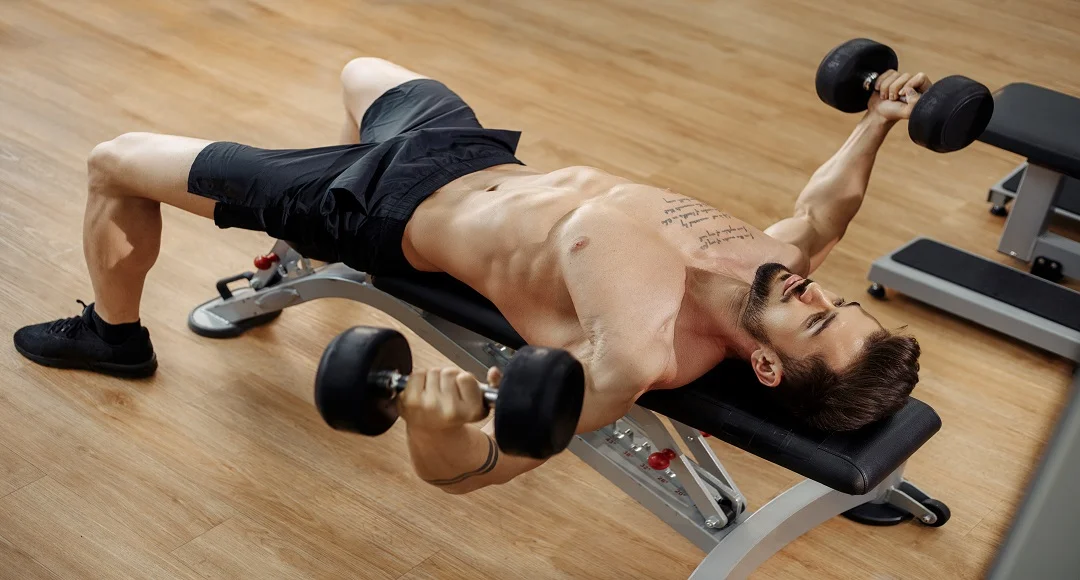
The incline dumbbell press (also known as the incline dumbbell bench press, dumbbell incline press or incline dumbbell chest press) is another pressing exercise performed on a set bench inclined between 15 and 45 degrees with a pair of dumbbells rather than a bar.
As opposed to the flat bench press, which mostly stresses just the middle and lower sections of the chest, the incline dumbbell press shifts a significant amount of tension away from this area and onto the clavicular head of pectoralis majoror what we tend to refer to colloquially as “the upper chest.” That top shelf of muscle up there is what rounds out the chest and gives it more fullness, especially when you’re wearing a T-shirt instead of posing shirtless under the lights at the gym.
Since you’re using dumbbells instead of a fixed barbell, each arm has to do the work on its own. Which means neither side can coast secretly on the other side’s strength, your shoulders travel through a more natural movement path and you achieve a deeper stretch at the bottom of the rep compared to what a barbell typically allows.
2. Muscles Worked
Knowing what is really going on under the hood allows you to feel the exercise properly — not just going through the motions.
Primary movers:
- Upper chest: ( clavicular head of pectoralis major): The main target for that “shelf” look right beneath the collar bone
- Dissect Anterior deltoid: Negatively affected; (front shoulder): predominantly activated at higher angles
- Triceps brachii: responsible for the lockout phase of the press
Secondary/stabilizing muscles:
- Standing up serratus anterior: stabilizes the shoulder blade against the ribcage
- Core / Lower Back: Maintain stiffness in the torso while on the bench
- Rotator cuff musculature: stabilizes the shoulder joint over the entire range of motion
Dumbbells also require more stabilization than a barbell, so the smaller support muscles around the shoulder joint get worked harder too. That’s also part of the reason that dumbbell incline bench press will generally destroy your shoulders more so than in the barbell version, even with lighter loads.
3. How to Do the Incline Dumbbell Press: Step-by-Step Form
That can mean the difference between an exercise that develops your pecs and one that just works out your shoulders. Here’s how to do it properly.
Step 1: Set the Bench Angle
Begin by adjusting your incline bench to 30-45 degrees We will dive deeper into the perfect angle in the next section, however 30 degrees is a very solid default for most lifters.
Step 2: Position the Dumbbells
Sit on a bench with dumbbells resting on both thighs. Hold the dumbbells at arms length with your palms facing in over the front of your legs. Brace your abs, hinge back to lean against the bench and drive one knee forward until it comes up to hip height as you pull a dumbbell between each knee hand towards one shoulder while keeping that same elbow on Gaya datssey/body position flat on tha lot. Your upper body should be at about a 45 degree angle when perform this exercise.
Step 3: Set Your Shoulder Blades
Just before you press, pull your shoulder blades down and back (as if stuffing them in your pockets). Maintain a small, natural curve in your lower back. It shields your shoulder joint and provides a strong foundation with which to press from.
Step 4: Position Your Elbows
Your upper arms should be ~45 to 75 degrees away from your torso (not flared straight out to the sides, which is rough on shoulders, and not tucked tight against your ribs—this turns it into a much more triceps-dominant press).
Step 5: Lower the Dumbbells
Lower the dumbbells slowly and controls until your upper arms are fairly level with the floor or you feel a good stretch across your upper chest. Your elbows should be tracking slightly forward and down, not right out to your sides.
Step 6: Press Up and Slightly In
Push the dumbbells upwards and slightly in, so that your dumbbell ends above your clavicle (upper chest) rather than directly over your shoulders. At the top, don’t let the dumbells bang against each other–just squeeze your chest.
Step 7: Control the Descent
Controlled decline of the weight back to the starting-point; 2-3 second descent Fight the impulse to bounce the dumbbells at the bottom of the movement — that’s where so much of the growth benefit comes from (in that stretched position), and rushing through it wastes a rep.
Quick form checklist:
- Flat feet on the ground for stability
- Shoulder blades pinned down and back the entire time
- Controlled tempo, specifically on the way down
- No shoulder pain with a full range of motion
- Dumbells should be at the top slightly inside instead of straight up
4. Best Incline Angle: 15, 30, or 45 Degrees?
This is one of the most asked questions regarding this exercise, and for a reason — the angle affects which muscles work hardest.
15 degrees: Very shallow incline. It only slightly de-emphasizes the middle pec, and still uses most of that mid-pec fiber. Decent for lifters looking to get the benefits of incline pressing without a heavy shoulder component, but it does not maximize upper chest activation.
30 degrees: This is the spot of “shut up take my money”. The pectoral muscle activation research seems to stick around roughly 30 degrees provides significant upper chest recruitment while controlling front delt relatively better than higher angles. This is the angle most coaches suggest as a default setting.
45 degrees: Still good for upper chest, but the higher you’re setting your seat during a press, the more activation is stratifying itself to the anterior deltoid (shoulder) rather than continuing with mid and upper pec. You’ll do well here if you’re a lifter whose upper chest responds better to a deeper stretch, but shoulder fatigue can present quicker.
So, incline dumbbell press should be 15 or 30 degrees? So for the vast majority of people who are after upper chest gains, 30 degrees is going to be a better option. It presses harder into the cleavicular head of the pec than 15 degrees does, without doing so much that it turns in to an overhead press with extra steps like 45 to 60 degrees often do. If you have a gym bench that doesn’t have an adjustable setting but sets at fixed increments, pick the setting nearest to 30 and only use 15 and 45 as auxiliaries.
5. Benefits of the Incline Dumbbell Bench Press
Upper chest development: This is the headline benefit. The biggest problem with most lifters is upper chest lagging the rest of their pecs simply because flat bench and push-ups don’t hit this area directly. The incline dumbbell chest press addresses this imbalance directly.
Better range of motion and shoulder health: Due to each arm moving independently, your shoulder blades have the means to move naturally throughout the pressing motion rather than being crammed into a pre-prescribed bar path. This can feel significantly easier on the joints than heavy barbell inclines over time.
Correcting strength imbalances: Barbell uses the stronger arm to compensate if one arm is stronger than the other. Dumbbells don’t allow that. That means each side has to carry its share of the load, balancing out asymmetries eventually.
More flexibility and range of motion: Dumbbells allow your hands to move below the level of your chest at the bottom of the rep, which a barbell simply cannot do. That little bit of extra stretch under tension is a powerful stimulus for growth.
More natural pressing path: Unlike with a barbell, your wrists and shoulders aren’t locked into one bar path so the motion tends to feel better for those who have limitations in shoulder range of motion.
Core and stability demands: Since you are controlling two separate loads on an angled plane, there is increased demand placed on the core, rotator cuff, and stabilizing muscles as opposed to machine variances.
6. How Much Weight Should You Use? (Strength Standards)
This is where it becomes more individualized, as your bodyweight, training experience, limb length and general pressing strength all come into play. However there are some general guides based on average strength levels for the dumbbell incline press (per dumbbell, not total combined).
| Level | Per-Dumbbell Weight (Male) | Per-Dumbbell Weight (Female) |
|---|---|---|
| Beginner | 15–25 lbs | 8–15 lbs |
| Intermediate | 30–50 lbs | 15–25 lbs |
| Advanced | 55–75 lbs | 25–40 lbs |
| Elite | 80 lbs+ | 45 lbs+ |
Is a 40 lb dumbbell incline press good?
40 lb dumbbells for reps, however, sits comfortably in the intermediate range — a stupendous working weight that most male lifters should be able to handle (that is, if you are doing full motions here and not half-assing this whole process). For many female lifters, 40 lb dumbbells would already be in the Advanced realm.
Is a 70 lb incline dumbbell press good?
Yes, quite good. 70 lb dumbbells with well-controlled reps is an advanced lifter and for most people in the gym this is gained over years of training not a few months. Qualitatively, the form is of greater importance here — 70s at full stretch and a controlled tempo will trump 70s with a two-inch range of motion any day of the week.
Is a 100 lb dumbbell incline press good?
No shit, this is basically a world-class pressing strength that virtually no recreational lifter attains. Actually pressing 100 lb dumbbells on an incline for real reps — not a shaky single — usually takes a solid overall base of pressing strength, than what is typically less than bodyweight and musclemass it took years of progressive training. If you are in this position, you’re ahead of most people who ever picked up a dumbbell.
The larger message: avoid these numbers at the expense of form. A 40 lb set with a full stretch and squeeze works more muscle than a bounced, half-range 80 lb set. Increase the weight only when you can stay within the technique defined earlier in the guide.
7. Common Mistakes to Avoid
Setting the bench too steep: Anything above 45–60 degrees just becomes a shoulder press. If this workout hits mainly your front delts, reduce the angle.
Flaring the elbows too wide: This causes undue strain to the shoulder joint and over time raises susceptibility to injury. Keep that 100–130 degree angle between your upper arm and torso (wardrobe alternative)
Bouncing dumbbells at the bottom: Sure it will allow you to use more weight, but you’re also giving up that stretching based growth stimulus and putting your shoulders in a seriously compromised position.
Failing to control the eccentric (lowering) phase: The lowering part of the lift is where a lot of muscle growth happens. Rushing it short-changes your results.
Not controlling your dumbbells far drift back: You are using data until October 2023 The dumbbells traveling behind the ears at the bottom of the rep means that at heavy loads, you’re forcing your shoulder joint to go into a position it should not be in.
Ego lifting. The number one reason people plateau: or get hurt doing this exercise is picking a weight you can not control through a full range of motion.
Skipping the shoulder blade setup: When not remembering to retract and depress the shoulder blades before pressing, stability is removed from the movement, unwanted stress appears on the front of your shoulder.
8. Incline Dumbbell Press Variations
Incline dumbbell press: neutral grip: palms face each other instead of forwards. This is usually less harsh on the shoulders and highlights the triceps and inner chest a bit more.
Incline dumbbell fly: This is an alternate way to isolate the chest without assistance from the triceps—great as a finisher once your pressing work is done.
Alternating press with incline dumbbell: One side presses while the other holds at the top This introduces a real stability and anti-rotation challenge through the body.
Single-arm incline dumbbell press: An even more challenging stability version which can help address muscle imbalances directly.
Incline dumbbell squeeze press: Press together through the entire rep. It greatly increases inner chest activation.
Low-incline dumbbell press (15 degrees): Useful for lifters who want incline benefits while slightly reducing overall shoulder contribution, or as a deload-style variation.
9. Programming: Sets, Reps & Frequency
The incline dumbbell press is responsive to the following parameters for most goals:
- Hypertrophy (muscle building): 3–4 sets of 8–12 reps Moderate to heavy weight, controlled tempo Rest: 60-90 seconds
- Strength: 3–5 sets of 4–6 reps, heaviest weight, 2–3 minutes rest
- Endurance/pump work: 2–3 sets of 15–20 reps, lighter weight, 45–60 seconds rest
Use it once or twice per week as your main upper-chest exercise, preferably early in your chest-or push-day workout when you’re most fresh and can stabilize the muscle better. Because it requires more shoulder stability than machine presses, it is generally performed earlier in the workout before isolation exercises such as fly’s or cable crossovers.
10. Incline Dumbbell Press vs. Barbell Incline Press
Both have value — but are not equivalent.
As such, the basic barbell incline press consistently permits you to shift more total weight than a dumbbell variation, rendering it an excellent option for absolute strength work. On the other hand, the incline dumbbell bench press provides can be more comfortable on shoulder joint integrity for lifters with mobility restrictions; has a slightly larger range of motion than the barbell version; and has better force breaking capabilities supporting equal development between sides.
A plethora of well-balanced programs implement both — barbell incline for raw power, dumbbell incline for asymmetry correction, joint-friendly range of motion and that additional stretch in the bottom position.
11. Frequently Asked Questions
Is a 70 lb incline dumbbell press good?
Yes. Pressing 70 lb dumbbells with full range of motion and control puts you in advanced territory for most male lifters, representing solid, well-earned pressing strength built over years of consistent training.
Should incline dumbbell press be 15 or 30 degrees?
For most lifters targeting upper chest growth, 30 degrees is the better default — it maximizes upper pec activation without shifting too much load onto the front delts, which tends to happen at steeper angles.
Is a 40 lb dumbbell incline press good?
For men, 40 lb dumbbells represent a solid intermediate working weight. For women, this is typically an advanced-level weight. Either way, if your form stays clean through a full range of motion, it’s a genuinely good number.
Is a 100 lb dumbbell incline press good?
Yes, this is elite-level strength that few recreational lifters ever reach. It reflects years of progressive, well-structured training and a strong overall pressing foundation.
12. Final Thoughts
Its places in nearly every serious chest routine are justified due to its unique benefit over flat pressing: it isolates the upper pec and allows each arm to track through its natural, joint-friendly path. Whether you’re chasing your first clean pair of 40s or progressing to triple-digit dumbbells, the principles remain constant—set the bench angle to roughly 30 degrees, focus on controlling every rep, and let heavy weights come as you earn them rather than forcing it. Nail those factors, and this exercise will deliver genuine upper chest transforms, as opposed to a (greater) number on the dumbbell rack.
Read More: Split Squat: How to Perfect Your Form for Maximum Leg Growth