
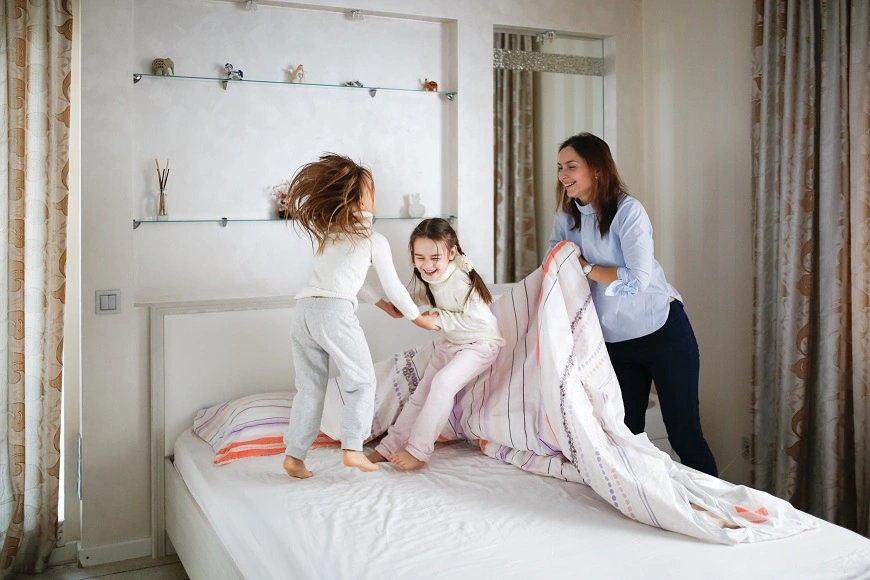
The single bed is the default of childhood. It fits a small room, suits a small person, and seems like it will do the job indefinitely. Then one day a parent notices their child’s feet are not far from the end of it, or that the once-roomy bed now looks distinctly snug around a growing teenager. The single has quietly stopped being big enough, and the question of moving up to a double arrives. It is a bigger change than it sounds, in cost, in space, and in what it signals, and it is worth thinking through rather than putting off indefinitely.
The bed that gets outgrown
Children grow in a way that catches parents out, and the single bed is often the thing they outgrow without anyone quite noticing. A bed that swallowed a small child looks very different with a lanky pre-teen or teenager in it. Feet reaching the footboard, a body that has to curl to fit comfortably, and restless sleep in a bed that no longer offers room to move are all signs the single has been outgrown. Unlike outgrowing clothes, which is obvious and immediate, outgrowing a bed is gradual, so it tends to be tolerated for longer than it should be.
Why room to move matters for sleep
A bed that is too small does more than look cramped; it interferes with sleep. Growing bodies move in the night, and a bed with no room to stretch or roll forces a sleeper to stay curled or wake to reposition. Teenagers in particular need good sleep for growth and the demands of school, and a bed that constrains them works against that. Giving an older child or teenager more space to sleep is not indulgence; it is removing an obstacle to the rest they need at exactly the age they need a lot of it. The extra room translates fairly directly into less disturbed nights.
Making the jump to a double
When the time comes, the move is usually from a single straight to a double, skipping the small double in many homes, because the aim is a bed that will last well into adulthood. Choosing from double mattresses for a standard double bedroom gives a teenager a bed they can grow into rather than out of, one that will still suit them when they are fully grown and likely for years beyond. It is a purchase that, made once at the right point, can serve through the rest of childhood, the teenage years, and the first stretch of adult life, which makes the cost easier to justify than its size first suggests.
Whether the room can take it
The honest constraint is space, because a double bed needs considerably more floor than a single, and not every child’s room can spare it. Before committing, it is worth measuring the room and picturing the double in place, leaving enough space to move around it and to fit whatever else the room needs to hold. In a genuinely small room, the choice may be between a double bed and room for a desk and storage, and that trade-off deserves real thought. Sometimes the room can be rearranged to make a double work; sometimes a small double is the sensible compromise. The decision has to fit the actual room, not the ideal one.
Timing the change well
There is no fixed age for the move, since it depends on the child’s size, the room, and the household’s circumstances, but a few cues help. A child whose feet are near the end of the single, who is clearly growing fast, or who is sleeping poorly in a cramped bed is signalling that the time is near. It is sensible to make the change at a settled moment rather than alongside other upheavals, and to treat it as a deliberate upgrade rather than an emergency once the single has become plainly too small. Acting a little before it becomes urgent is gentler on everyone than waiting until the child is visibly too big for their bed.
The mattress matters as much as the frame in this move, and it is worth not skimping on it. A double frame paired with a thin or poorly supportive mattress wastes much of the benefit of the extra space, since a growing teenager needs proper support as well as room to spread out. Choosing a mattress built to support a near-adult body, rather than the cheapest one that fills the frame, is what makes the larger bed deliver better sleep rather than just more surface area. The point of sizing up is comfort and rest, and the mattress is where most of that comfort actually comes from.
A bed for the years ahead
The reason the jump to a double is worth getting right is that it is, for many children, the last bed of childhood and the first of adulthood. A double chosen well at the right time stops being a children’s purchase and becomes simply their bed, the one they will sleep in through exams, through growing up, and often as they leave home. Seen that way, it is less an expense to flinch at than an investment in years of good sleep for a person who is nearly grown. The single served its purpose; recognising when it has been outgrown, and replacing it with a bed built for the years ahead, is just keeping pace with a child who has not stopped growing.
Read More: Tvlio: Review Is This IPTV Service Legit or a Scam? [Tested]